Richard Feynman’s Wobbling Plate and Useful Curiosity
Richard Feynman’s wobbling plate story shows why useful ideas often begin as play - and why a Second Brain should bring old curiosities back into view.
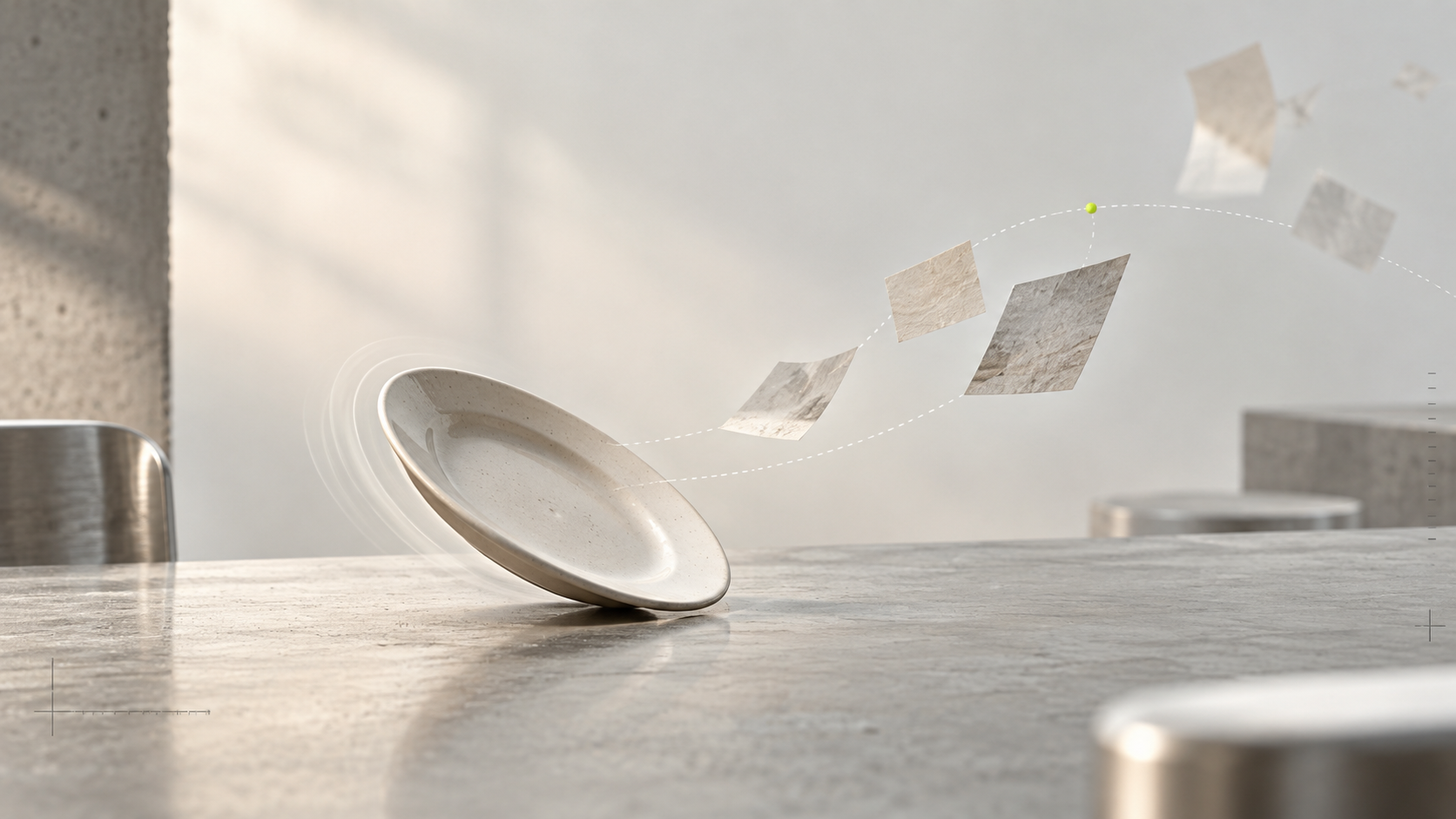
One of modern physics’s most memorable curiosity stories begins with an object so ordinary that most people would have watched it fall and returned to lunch.
A plate was tossed through a Cornell cafeteria. It spun, wobbled, and briefly gave Richard Feynman a problem that seemed to have no practical value at all. He followed it anyway.
The lesson is not that every distraction hides a Nobel Prize. It is that usefulness is often visible only after a question has been given time to develop.
The wobbling plate that made physics enjoyable again
In Feynman’s later account, someone in the Cornell cafeteria threw a plate into the air. The university emblem rotated while the plate wobbled, and the two motions appeared to follow a regular relationship. Feynman began calculating the dynamics simply because the problem caught his attention.
A later analysis in the American Journal of Physics reconstructs the episode and the mechanics. The plate was a real classical-physics problem: a spinning disc with angular momentum, changing orientation, and a measurable relationship between its spin and wobble. It was playful, but it was not trivial.
Feynman said that pursuing the plate drew him toward questions about electron motion, the Dirac equation, and quantum electrodynamics. He later described the Nobel-related work as growing from his “piddling around” with the plate, a recollection quoted and examined in SIAM’s explanation of the wobble.
The destination matters, but so does the wording. This was Feynman’s retrospective account of how he recovered momentum and enjoyment. It is not proof that the plate single-handedly produced quantum electrodynamics.
The 1965 Nobel Prize in Physics was shared by Feynman, Sin-Itiro Tomonaga, and Julian Schwinger for fundamental work in quantum electrodynamics. Feynman’s own Nobel lecture describes a much longer development stretching back years before the cafeteria episode.
The plate was not a magic origin story. It was a door back into attention.
Why a useless question can become useful later
A useful idea rarely arrives carrying a label that explains where it belongs. At first, it may be only a pattern, contradiction, image, or question that refuses to leave you alone.
Demand an immediate application, and many such ideas fail the test. Their value depends on information you have not encountered yet. A question from physics may later clarify a problem in design. A detail from history may explain a modern technology. A note from a book may become relevant only after a conversation months later.
Connections are often retrospective: the second idea changes the meaning of the first.
That is also why distant subjects can illuminate each other. Our article about the hidden connection between telephones and skyscrapers links a desk device to tall-building economics through a shared bottleneck: moving information without moving a person. Neither subject announces that connection in advance. It appears when both are held in view long enough to reveal the mechanism between them.
Feynman’s story offers the same practical permission. You do not need to predict the final use of a question before allowing yourself to explore it. You need enough attention to notice what the question is doing.
A Second Brain needs a return path
Most note systems are excellent at capture. A link disappears into a folder, a quote enters a database, and an interesting thought receives a tag. The library grows while the ideas become harder to see.
That failure mode is explored directly in the problem of digital hoarding in Second Brain apps. Storage is useful, but storage alone does not create recall, understanding, or connection. An idea has to return to attention before it can interact with what you know now.
A practical Second Brain therefore needs three rules.
1. Save what makes you curious
Do not capture only polished conclusions or material with an obvious project attached. Save the strange example, unresolved question, visual pattern, or sentence that creates tension.
Add one line explaining why it caught you. That small note preserves the signal that made the item worth saving when the surrounding context fades.
2. Do not force the connection immediately
Premature organization can make a note look finished before you understand it. Give uncertain ideas a place to wait without inventing a confident category or lesson.
Record what you observed, what remains unclear, and any tentative connection as a possibility rather than a fact. Let later evidence strengthen, change, or kill the idea.
3. Bring old ideas back
A saved curiosity cannot connect with today’s problem while it remains invisible. Review, resurfacing, and retrieval create new encounters between old material and current attention.
This does not mean rereading an entire archive. Return a small number of ideas at useful intervals. Ask what each one means now, what it contradicts, and what new question it creates.
The point of resurfacing is not repetition for its own sake. It is controlled collision.
How to practice useful curiosity without romanticizing randomness
Feynman’s story is inspiring partly because we know the ending. That creates selection bias: history remembers the playful question that connected to celebrated work, not the many curiosities that led nowhere.
So the lesson should remain modest. Curiosity is not a guarantee of importance, and aimless browsing is not automatically creative work. The productive habit is to make room for low-stakes exploration while keeping standards for evidence and follow-through.
Try this lightweight workflow:
- Keep a curiosity inbox for questions that interest you before they seem useful.
- Preserve the source and separate observation from interpretation.
- Revisit a few old items each week instead of scrolling the whole archive.
- When a connection appears, write the mechanism that links the two ideas.
- Keep dead ends. They protect you from retelling exploration as if success were inevitable.
This approach respects both sides of the story. Play can open a path, but patient work determines whether the path goes anywhere.
The rule worth remembering
Feynman could not have known, at the cafeteria table, how he would later describe the plate’s place in his career. That uncertainty was not a flaw in the process. It was the condition that made genuine exploration possible.
Save broadly. Judge slowly. Revisit deliberately.
The useful connection may not be inside the idea you saved. It may appear when that old idea meets the person you have become.
Sources and further reading
- The Nobel Prize in Physics 1965 — the shared award to Sin-Itiro Tomonaga, Julian Schwinger, and Richard Feynman for work in quantum electrodynamics.
- Richard P. Feynman’s Nobel lecture — Feynman’s longer account of the development of his approach to QED.
- Feynman’s wobbling plate, American Journal of Physics — a technical reconstruction of the cafeteria story and plate dynamics.
- Feynman’s Flying Saucer Explained, SIAM News — an accessible explanation of the wobble and Feynman’s retrospective account.