The Telephone and Skyscrapers: The Hidden Connection
Elevators moved people, but telephones moved information. Discover the hidden bottleneck that helped dense skyscraper offices become economically practical.
One of the most important technologies in a skyscraper never travels between floors. It sits on a desk.
The elevator is the obvious hero of the skyscraper story. It made the upper floors reachable. Steel framing made them structurally possible. But height created another problem: a tall office building concentrates thousands of conversations, requests, approvals, orders, and updates in one place.
Before those messages could travel electrically, many of them had to travel physically. Someone had to carry them.
That is the hidden connection between the telephone and skyscrapers: the elevator moved people, while the telephone moved information. Together, they helped dense office buildings work.
🎞️ Prefer the visual version? View the short TikTok slides.
The telephone and skyscrapers solved different problems
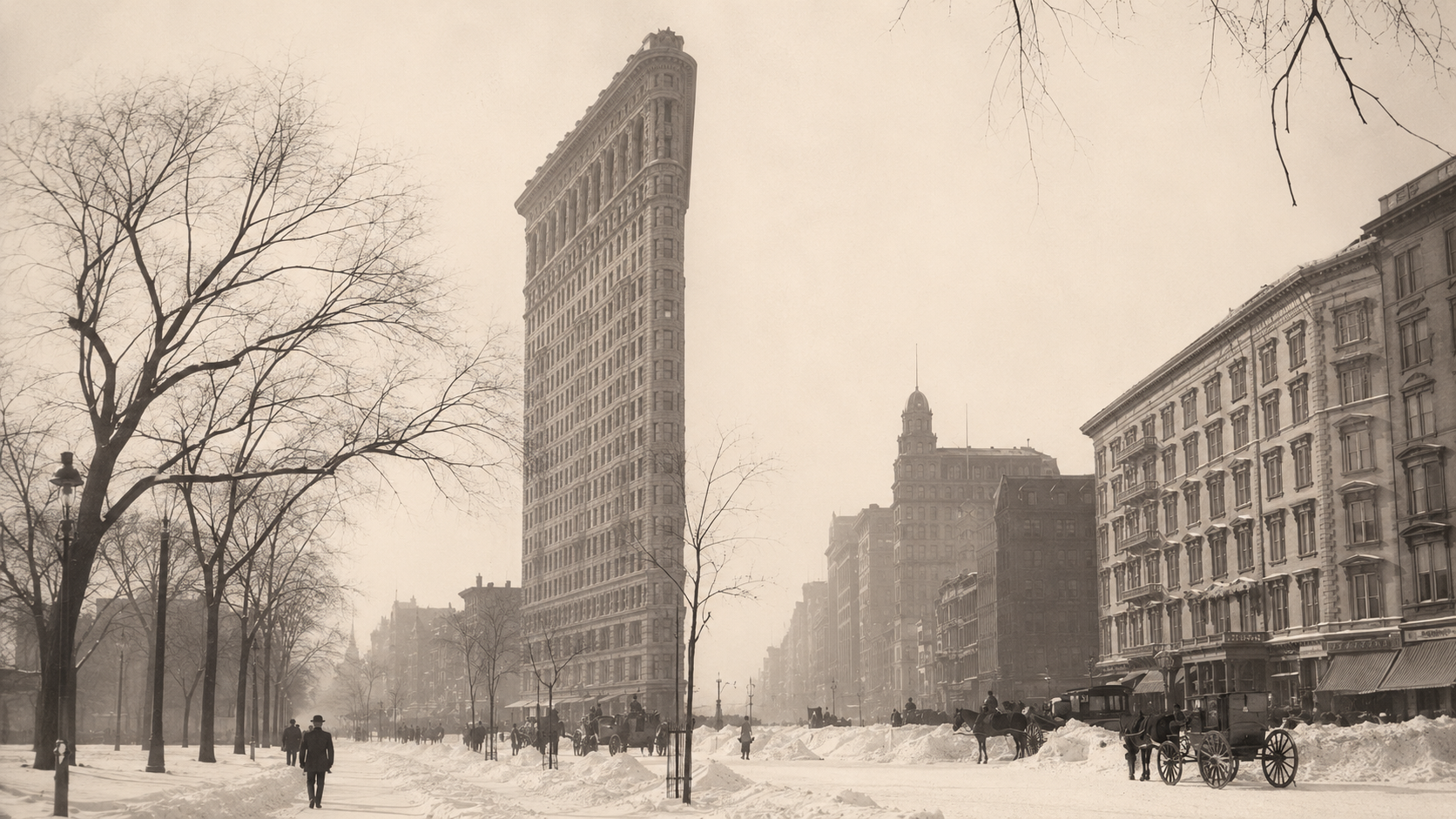
By the early twentieth century, New York’s skyline was already changing. The Flatiron Building was completed in 1902, and taller towers soon followed. Passenger elevators and steel-frame construction were essential parts of this transformation. The Library of Congress describes their combination as making skyscraper development possible.
But making a tall building possible is not the same as making it economical.
An office tower has to move more than bodies. It also has to move decisions. A manager needs a report from another floor. A customer needs an answer. A clerk needs authorization. A department needs to tell another department that something has changed.
Without instant communication, every one of those exchanges risks becoming a trip through a corridor, stairwell, or elevator.
The skyscraper therefore had two circulation systems:
- A physical system for moving people and goods.
- An information system for moving messages and decisions.
The telephone reduced the pressure on the first system by improving the second.
A Bell engineer made the case
John J. Carty became AT&T’s chief engineer in 1907. One year later, he offered a vivid thought experiment about the modern office building.
As James Gleick recounts in The Information, Carty asked people to imagine a giant office building without telephones. Every message would need a personal messenger. Those messengers would require additional elevator capacity, leaving less room for offices. Carty called the result an “economic impossibility.”
The logic can be reduced to three lines:
No phones = people carry messages
More messengers = more elevator traffic
More elevator traffic = less profitable skyscrapers
Carty’s point was not merely that phone calls were faster than written messages. He was describing a system-level effect. A message that could travel through a wire no longer required a body to occupy a hallway or elevator car.
An invention can matter because of the trips that no longer happen.
The telephone did more than save time
Imagine a ten-story office with hundreds of workers. A request from the tenth floor must reach someone on the second floor. If the message is carried by hand, one small exchange consumes several resources: a messenger’s time, space inside the elevator, elevator energy and capacity, and time for both sender and receiver.
Multiply that exchange across departments, companies, and working days. The cost is no longer just a few minutes. It becomes congestion built into the architecture.
The telephone changed the unit of movement. Instead of moving a person carrying information, the building could move the information itself.
That mattered because elevator shafts compete with rentable floor area. More vertical traffic can require more cars, more shafts, or longer waits. The phone did not eliminate internal movement, and offices still used mailrooms, telegraph messengers, pneumatic tubes, and face-to-face meetings. But it removed a whole category of routine trips from the building’s circulation system.
This is why the telephone belongs in the skyscraper story even though it did not hold up a single beam.
Hidden bottlenecks explain technological change
We often explain technological change by looking at the most visible capability. Elevators go up, so they explain tall buildings. Cars move faster, so they explain suburbs. Artificial intelligence generates text, so it explains automation.
But the more useful question is: Which constraint disappeared?
The biggest technologies rarely change only one product. They alter costs, habits, coordination, and the shape of the systems around them. That is why technologies that change whole systems are better understood through the pressures they remove than through their most impressive demonstration.
In the early skyscraper, several constraints had to be solved together:
- Steel framing reduced the structural limits of masonry walls.
- Elevators reduced the effort required to reach upper floors.
- Telephones reduced the physical traffic required to coordinate work.
None of these technologies single-handedly created the modern skyline. Their value came from the way they reinforced one another.
The visible machine gets the credit. The hidden bottleneck explains the system.
How to find the hidden bottleneck
Carty’s thought experiment offers a practical way to study any new technology. Start with the outcome, then work backward through the constraints.
Ask five questions:
- What are people trying to accomplish? In an office tower, they are not merely reaching a floor; they are coordinating work.
- What scarce resource is becoming congested? It could be elevator capacity, attention, time, storage, trust, or expertise.
- What work exists only because information cannot move easily? Messengers were useful, but many trips existed because the message could not travel alone.
- What becomes more valuable when the constraint disappears? Faster communication made dense, high-rise office space more useful.
- What new bottleneck appears next? Solving communication speed can expose problems in decision-making, organization, or attention.
The same lens can reveal why a small design decision can affect an entire system. The size of the solution does not tell you the size of the constraint it removes.
The same bottleneck appears in learning
Learning tools often focus on storage: save more PDFs, capture more notes, collect more links. Storage feels productive because it is visible. The library grows.
Yet the real goal is not to possess information. It is to retrieve and use it when needed.
That is why a Second Brain can turn into digital hoarding. The hidden bottleneck is often not capture but retrieval: returning to an idea, connecting it to prior knowledge, and testing whether it can be recalled.
Flashcards help when they remove that bottleneck. Turning a source into questions converts passive material into retrieval prompts. But generation alone is not learning. The learner still has to answer, check the explanation, revisit weak material, and connect one topic to the next.
The skyscraper lesson applies here too: do not judge a tool only by what it visibly creates. Ask which repeated cost it removes from the larger process.
What Carty’s story does not prove
The telephone did not invent the skyscraper, and skyscrapers were not literally waiting for one missing device. Elevator office buildings existed before Carty’s 1908 argument, and tall construction depended on engineering, fireproofing, electricity, land values, finance, regulation, and demand as well as communication.
Carty also worked for the telephone industry. His thought experiment was advocacy, not a published economic model with measured elevator traffic and rental returns. “Less profitable skyscrapers” is a clear summary of his mechanism, not a precise calculation.
That nuance makes the story stronger, not weaker. The useful claim is that communication technology changed the economics of density. The Skyscraper Museum includes telephone technology alongside elevators in the story of why early office buildings became taller, while Claude Fischer’s America Calling shows why the telephone’s effects should be understood through the people and institutions that adopted it.
The elevator moved people. The telephone moved information. Together with steel framing and many other systems, they helped skyscrapers become practical places to work.
Big change happens when technology removes a hidden bottleneck.
Sources and further reading
- James Gleick, The Information — the modern retelling of Carty’s skyscraper thought experiment.
- Library of Congress, “Otis and the Elevator” — elevator and steel-frame construction in skyscraper development.
- IEEE-USA, “Engineering Hall of Fame: John J. Carty” — Carty’s engineering career and appointment as AT&T chief engineer.
- The Skyscraper Museum, “New York’s First Skyscrapers: When, Where & Why?” — elevators and telephone technology in the development of early office towers.
- Claude S. Fischer, America Calling — a social history of telephone adoption in the United States.
- Library of Congress, Flatiron Building, circa 1902 — the historical image used for the carousel’s opening slide.